OCD Subtypes
(with real examples!)
What are OCD Subtypes?
When someone has obsessive thoughts, feelings, urges, or compulsions that revolve around specific topics, it can be helpful to group them under various subtypes.
Everyone with OCD has obsessions and compulsions, but each person can have a drastically different subtype than another.
Below are examples of the most common subtypes and details on how I use Exposure and Response Prevention Therapy (ERP) to treat them.
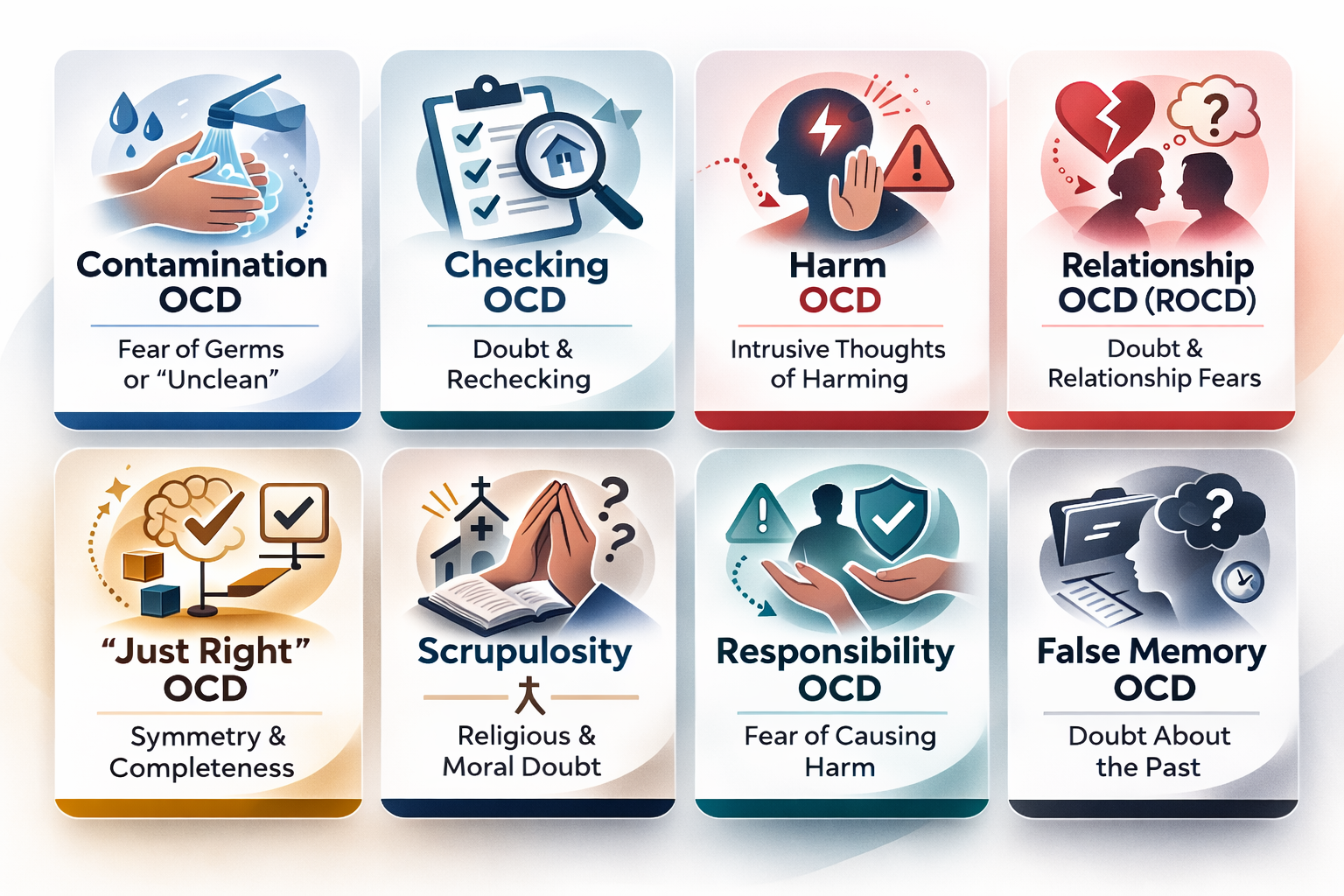
Click Link to Navigate
Contamination OCD involves fears of illness, germs, chemicals, or feeling “unclean,” leading to repetitive washing, avoidance, or cleansing rituals that temporarily reduce anxiety but reinforce the cycle.
In my work with clients, I’ve seen that contamination compulsions often start with sensible caution, but expand into the unreasonable until normal activities seem irresponsible.
Common Obsessions
“What if I get sick from this?”
“What if I contaminate someone else?”
“What if I touched something contaminated and didn’t realize it?”
Fear of chemicals or bodily fluids
Common Compulsions
Excessive handwashing
Avoiding public places or shared objects
Changing clothes repeatedly
Seeking reassurance about cleanliness
What This Is Not
Not simply liking cleanliness and general caution
Not normal hygiene
Contamination OCD
Checking OCD
Checking OCD centers on intrusive doubt about safety, mistakes, or responsibility, driving repeated checking behaviors or mental reviewing that, over time, causes distrust in one’s own memory.
I’ve seen that while people check to increase their confidence and assurance, they end up feeling more uncertain than when they started. Memory isn’t the issue — it’s trust.
Common Obsessions
“What if I missed something important?
“What if I left the stove on?”
“What if I didn’t lock the door?”
“What if I made a mistake?”
Common Compulsions
Mentally reviewing past actions
Repeatedly checking doors, appliances, or locks
Re-reading emails or documents multiple times
Seeking reassurance that things are safe
What This Is Not
Being detail-oriented
Double-checking something once for safety
Harm OCD
Harm OCD involves intrusive thoughts or images about hurting oneself or others, followed by compulsive behaviors meant to prevent something the person deeply does not want to happen.
Those who struggle with harm OCD are often some of the kindest and gentlest people I work with. Their incredible distress at these thoughts comes from how opposite these thoughts are from their values.
Common Obsessions
“What if I lose control and hurt someone?”
Graphic intrusive images
Fear of snapping unexpectedly
Doubt about one’s own intentions
Common Compulsions
Avoiding knives or sharp objects
Avoiding being alone with others
Seeking reassurance about being “safe”
Mentally reviewing whether you’d ever act on it
What This Is Not
A desire to cause harm
Being dangerous
Relationship OCD involves persistent doubt about one’s feelings, partner, or the “rightness” of a relationship, leading to compulsive analysis and reassurance-seeking.
What is more important to someone than their relationships? In my work with ROCD clients, I see how deeply they value their relationships — and how distressing it feels to fear they might be the reason it falls apart.
Common Obsessions
“Do I really love them?”
“What if there’s someone better?”
“What if I’m settling?”
Hyperfocus on partner’s flaws
Common Compulsions
Repeatedly evaluating feelings
Comparing partner to others
Seeking reassurance about compatibility
Mentally replaying interactions
What This Is Not
Normal relationship doubts
Being incompatible
Relationship OCD (ROCD)
“Just Right” OCD involves an intense need for symmetry, order, or internal completeness, leading to repetitive behaviors until things feel correct.
Often, clients who have this subtype describe a feeling/urge of an unbearable internal tension rather than a fearful thought. The urge to make things feel “right” can often feel like the only solution to living with that internal tension.
Common Obsessions
“It doesn’t feel even.”
“Something is off.”
Distress over asymmetry
Urge for internal completeness
Common Compulsions
Rearranging objects repeatedly
Repeating actions until they feel right
Touching or tapping evenly
Rewriting or reformatting
What This Is Not
Preferring organization
Being detail-oriented
“Just Right” / Symmetry OCD
Religious scrupulosity involves obsessive fears of sinning or offending God, followed by compulsive attempts to gain certainty about moral or spiritual standing.
Individuals suffering from the religious OCD subtype often have deep faith and a desire to follow God. This subtype focuses on the eternal consequences of not being certain about salvation or eternal punishment. How do we move through this? Learn to live with faith. Faith = Living with uncertainty.
Common Obsessions
“What if I committed the unpardonable sin?”
Fear of eternal punishment
Intrusive blasphemous thoughts (ex: harm or sexual thoughts about God)
Doubt about the sincerity of one’s faith
Common Compulsions
Repetitive prayer for reassurance, protection, etc.
Excessive confession, prayer, or scripture reading (ex: repeated prayers for salvation)
Seeking reassurance from clergy/pastors
Avoiding perceived spiritual risks
What This Is Not
Strong religious belief
Healthy spiritual reflection
Scrupulosity (Religious OCD)
Responsibility OCD centers on exaggerated fears of causing harm through negligence, leading to compulsive checking and reassurance-seeking.
Many clients feel responsible not just for their actions, but for preventing every possible negative outcome.
Common Obsessions
“What if this is my fault?”
Fear of missing something important
Catastrophic “what if” scenarios
Fear of being blamed
Common Compulsions
Repeated checking
Excessive apologizing
Seeking reassurance
Avoiding decisions
What This Is Not
Being conscientious
Taking normal responsibility
Responsibility OCD
False Memory OCD involves persistent doubt about past actions, leading to compulsive mental review to determine whether something harmful occurred. I’ve seen that this subtype isn’t about memory itself, but rather about needing certainty about the past.
Common Obsessions
“What if I did something wrong and forgot?”
Doubt about past conversations
Fear of hidden wrongdoing
Questioning memory accuracy
Common Compulsions
Replaying events repeatedly
Searching for proof
Asking others for confirmation
Confessing “just in case”
What This Is Not
Having a bad memory
Intentionally concealing harm
False Memory OCD
Real Event OCD involves obsessive rumination about actual past mistakes, accompanied by compulsive attempts to resolve guilt or achieve moral certainty. While there may be real events that have happened, I find that the endless rumination is what separates this from normal regret.
Common Obsessions
“What if what I did was unforgivable?”
Replaying past mistakes
Fear of being exposed
Excessive guilt
Common Compulsions
Mental review of the event
Seeking reassurance about morality
Confessing repeatedly
Self-punishing thoughts
What This Is Not
Normal regret
Genuine unresolved wrongdoing
Real Event OCD
SO-OCD involves intrusive doubts about one’s sexual orientation, followed by compulsive checking of thoughts, feelings, or attraction. From constantly scanning one’s body to testing their attractions, people who have this subtype come into my office terrified that they may be in denial or are fearful that they are in the wrong relationship.
Common Obsessions
“What if I’m actually a different orientation?”
Hyperawareness of attraction
Fear of being in denial
Doubt despite long-standing identity
Common Compulsions
Monitoring arousal
Comparing reactions to others
Seeking reassurance
Testing attraction
What This Is Not
Questioning identity in a healthy way
Discovering one’s orientation
Sexual Orientation OCD (SO-OCD)
Magical Thinking OCD involves the belief that thoughts, words, or small actions can cause unrelated events, leading to ritualistic behaviors to prevent harm. What I’ve seen is that clients often realize that the logic OCD is wanting them to believe doesn’t hold up, but the fear feels so real that they don’t feel like they have a choice.
Common Obsessions
“If I think it, it might happen.”
Fear of jinxing something
Associating unrelated events
Overestimating symbolic meaning
Common Compulsions
Performing rituals to “cancel out” thoughts
Avoiding certain numbers or words
Repeating phrases mentally
Superstitious behaviors
What This Is Not
Cultural differences
Playful superstition
Magical Thinking OCD
Sensorimotor OCD involves obsessive focus on automatic bodily sensations. This hyperfocus on automatic body functions causes intense distress as they try to force themselves to feel automatic again. However, they fall victim to the principle of “Don’t think of a pink elephant,” which means that as they try not to think about sensations, all they can do is dwell on them.
Common Obsessions
Awareness of breathing
Swallowing or blinking focus
Heartbeat monitoring
Fear of never “un-noticing”
Common Compulsions
Checking bodily sensations
Testing control
Researching symptoms
Avoiding quiet environments
What This Is Not
A medical disorder
Normal body awareness
Sensorimotor (Somatic) OCD
Existential OCD involves intrusive, distressing questions about reality, meaning, or existence that become compulsive and unresolvable. Existential questions can be fun to think about! However, this subtype latches onto existential themes and never lets you rest as OCD demands an answer to these questions, and there is no way to gain 100% certainty for them.
Common Obsessions
“What if nothing is real?”
“What is the meaning of life?”
Fear of solipsism
Distress about reality
Common Compulsions
Endless philosophical rumination
Researching metaphysics
Seeking reassurance
Mental debate
What This Is Not
Normal curiosity
Philosophical interest
Existential OCD
Moral scrupulosity involves obsessive fears of being unethical or immoral, followed by compulsive attempts to ensure moral purity. These clients often hold themselves to harsher standards than they would ever apply to others.
Common Obsessions
“What if I’m a bad person?”
Fear of hidden bias
Excessive guilt
Overanalyzing intentions
Common Compulsions
Replaying interactions
Seeking reassurance
Confessing minor issues
Avoiding moral risk
What This Is Not
Caring about ethics
Personal growth
Moral OCD
Suicidal OCD involves intrusive fears of harming oneself despite no desire to die, followed by compulsive efforts to gain certainty about safety. This is very different from a client who has a desire to die. The suicidal OCD subtype takes a person who doesn’t want to die and inserts intrusive thoughts/images of them dying.
Common Obsessions
“What if I lose control?”
Fear of impulsively acting
Disturbing intrusive images
Doubt about safety
Common Compulsions
Avoiding sharp objects or heights
Seeking reassurance
Monitoring thoughts
Repeating safety checks
What This Is Not
Suicidal intent
A desire to die
Suicidal OCD
POCD involves intrusive fears of being attracted to children, followed by compulsive checking and avoidance to gain certainty about one’s character. In my experience, individuals with POCD are often deeply values-driven and highly protective of children — which is exactly why these thoughts feel so horrifying. The distress, avoidance, and urgency to prove “I would never do that” are strong indicators that the thoughts are ego-dystonic and rooted in OCD, not desire.
Common Obsessions
“What if I’m attracted to children?”
Fear of being a monster
Hyperawareness of bodily sensations around children or media that has children present
Doubt about past interactions/intentions
Common Compulsions
Avoiding children
Monitoring physical responses
Seeking reassurance
Mental reviewing past encounters
What This Is Not
Pedophilic desire
Hidden intent
Pedophilia OCD (POCD)
Facing OCD Together
No Matter the Subtype —ERP Can Help!
OCD can make you feel trapped in a cycle you don’t fully understand. Evidence-based treatment, like Exposure and Response Prevention (ERP), helps you face these thoughts safely without letting them control your actions. Through guided practice, you’ll learn practical strategies to reduce compulsions, manage anxiety, and reclaim your freedom—step by step — no matter the content of your thoughts/feelings/behaviors!
A Safe, Supportive Approach
I specialize in OCD treatment here in Knoxville and have worked with many clients navigating intrusive thoughts. I know how isolating and exhausting OCD can feel. My approach combines ERP with supportive guidance tailored to your unique situation, so you can move forward at a pace that feels manageable and safe.
Next Steps
If you’re ready to start reclaiming control over your mind, you can fill out the contact form below to schedule a session or ask questions directly. If you want to learn more first, you can check out our FAQ page for details about ERP, what to expect in therapy, and how other clients have found relief.
Contact Cade
Take the Next Step — At Your Own Pace
Reaching out for help can feel hard, especially if you’re unsure whether therapy—or ERP—is right for you. That uncertainty is common with OCD. This is simply a first step to ask questions, learn more, or see if working together makes sense.
Filling out the form is no commitment. You’re not locking yourself into therapy—just starting a conversation.
What Happens After You Reach Out
I’ll review your message personally
I’ll follow up to answer questions or discuss next steps
You can decide how (or if) you want to move forward
If you’d like more information before reaching out, you can also visit the FAQ page to learn more about ERP, what therapy looks like, and what to expect. I look forward to hearing from you!