Religious OCD / Scrupulosity: Fear Disguised as Faithfulness
Many people with scrupulosity are deeply sincere, thoughtful, and committed to their faith. The problem is not that they care too much about God — it’s that OCD takes spiritual questions and turns them into endless demands for certainty.
Instead of faith bringing peace, faith becomes dominated by fear:
Fear of missing a sin
Fear of not being truly forgiven
Fear of not being “saved enough”
Fear of offending God without realizing it
For some people, this can look like repetitive confession, compulsive prayer, hours of rumination, constant reassurance-seeking, or endlessly analyzing whether they are spiritually safe.
What begins as a genuine desire to follow God can slowly become an exhausting cycle of anxiety and compulsions.
What Is Scrupulosity?
Scrupulosity is a form of OCD centered around moral or religious fears. Like other forms of OCD, it follows the same cycle:
An intrusive doubt, thought, fear, image, urge, or feeling appears
Anxiety rises
A compulsion is performed to reduce uncertainty
Relief comes briefly/temporarily
The doubt returns stronger
The content may be spiritual, but the process is OCD.
Scrupulosity is not strong faith. It is OCD attaching itself to what matters most.
Common Signs of Scrupulosity
Common obsessions/intrusive thoughts may include (but are not limited to):
“Did I commit the unpardonable sin?”
“Did I blaspheme the Holy Spirit?”
“What if I sinned and didn’t realize it?”
“What if my repentance wasn’t sincere enough?”
“What if I’m not truly saved?”
“What if I offended God with that thought?”
“What if I forgot to confess something important?”
“I have terrible/horrible taboo thoughts about God/Satan that I can’t get rid of”
“I am evil.” “I worship the Devil.” “I hate my friends/family/relationships.”
Common compulsions may include:
Repetitive confession
Excessive prayer for reassurance
Mentally reviewing past actions for sin
Seeking reassurance from pastors, priests, friends, or online forums
Re-reading Scripture to feel certain
Avoiding situations that feel spiritually risky
Repeating prayers “correctly”
Trying to push thoughts away
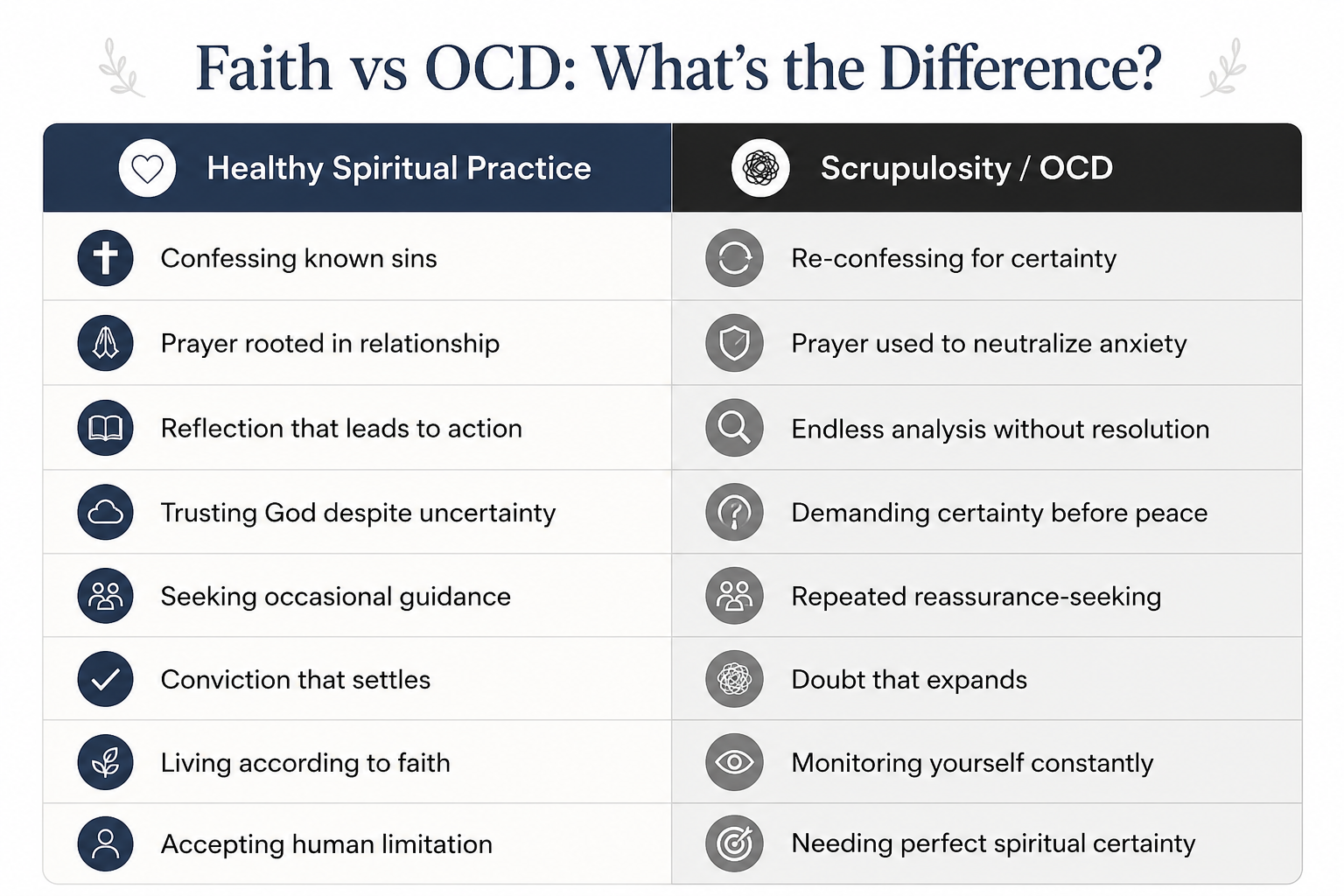
Questions That Indicate Compulsive Process
Am I confessing because I committed a known sin, or because I need certainty that I didn’t miss one?
When I finish confessing, do I feel resolved, or do I feel the urge to review whether I confessed correctly?
Am I seeking forgiveness, or am I seeking the feeling of certainty that I’m forgiven?
How many times have I confessed this same issue?
If I were 100% certain that God had forgiven me, would I still feel the need to repeat this confession?
Is this driven by conviction, or by anxiety?
I’ve worked with clients who spend hours trying to push “sinful,” terrible thoughts out of their heads. Only to find that it is that exact pushing that keeps their attention focused on those terrible thoughts.
This endless pushing/distraction/avoidance keeps them exhausted and terrified, thinking the following:
“I can’t keep living life this way”
“Where is the peace that was promised me?”
"Why am I having these thoughts?”
“Is this spiritual oppression?”
“I’m so exhausted; will this ever end?”
-
This is often the core struggle in scrupulosity. The stakes are too high.
A person may recognize that compulsive rumination is not helping, yet still feel unable to stop because the consequences feel too important.
However!
If salvation matters, does analyzing it for three hours create certainty?
If sin matters, does reviewing your memory fifty times prove what happened? Do you feel more confident after mental review?
If God’s judgment matters, can rumination reliably determine it?
The consequences may matter deeply. But importance does not change whether compulsive rumination can actually solve the question.
From an ERP perspective, the goal is not to stop caring about faith. The goal is to stop using compulsions to achieve absolute certainty.
-
This struggle is not new — people have wrestled with obsessive spiritual doubt and compulsive attempts to feel morally certain for thousands of years.
Historically, many Christian leaders — especially within Catholic tradition — recognized that excessive spiritual doubt could become unhealthy and compulsive.
Common guidance historically included:
Working with one confessor rather than seeking multiple opinions
Not repeating confessions
Not re-confessing sins already absolved
Not analyzing doubtful sins
Trusting spiritual authority over anxious self-analysis
Historical figures with scrupulosity:
Martin Luther reportedly spent hours in confession, repeatedly reviewing minor actions and thoughts because he feared he had not confessed thoroughly enough or offended God without realizing it. His confessors eventually became frustrated by the endless repetition and reassurances he sought.
John Bunyan, the English preacher and author of The Pilgrim’s Progress, described terrifying intrusive thoughts, fears of damnation, compulsive spiritual analysis, and relentless doubts about whether he had committed the unforgivable sin.
Both men appeared deeply sincere in their faith, yet became trapped in cycles of fear, doubt, and compulsive attempts to achieve certainty.
-
Scrupulosity often feels like:
“I can never feel spiritually settled.”
“Every thought feels morally loaded.”
“Relief never lasts.”
“I need to read another book, listen to another podcast, or ask another pastor to get answers to my questions.”
“I’m so incredibly exhausted by these thoughts; maybe I should just give up”
Why Reassurance Does Not Last
People with scrupulosity often experience temporary relief after confession, reassurance, prayer, or analysis.
But the relief usually fades quickly.
This is because compulsions teach the brain:
“This fear must have been real if we need to do something to feel safe.”
As a result, the brain has learned that this false alarm should be perceived as a real all-hands-on-deck fire alarm.
Over time, reassurance stops resolving the fear and starts maintaining it and making it worse.
How ERP Helps Scrupulosity
Exposure and Response Prevention (ERP) is considered the gold-standard treatment for OCD, including scrupulosity.
ERP does not teach people to abandon faith or stop caring about morality.
Rather, ERP helps people:
Resist compulsive confession and reassurance-seeking
Stop mentally reviewing for certainty
Tolerate uncertainty about spiritual questions
Return attention to daily responsibilities and values
Build a relationship with faith that is not driven by fear
Relax into a deeper trusting relationship where they are held by God rather than desperately swimming in an ocean of chaos.
This often means learning that certainty is not required to move forward faithfully.
Final Thoughts
If your spiritual life feels dominated by fear, compulsive analysis, guilt, or the constant need for certainty, you may not be struggling with a lack of faith.
You may be struggling with OCD.
Scrupulosity can feel isolating, frightening, hopeless, and utterly exhausting. But it is also highly treatable!
If you have questions or would like to begin ERP therapy either online or in-person in Knoxville, TN, reach out today!
Side Note: This is by no means an exhaustive list of all things Religious OCD. Many scrupulous obsessions/compulsions are not listed here. If you are wondering whether what you’re struggling with falls into OCD, reach out for a free 15-minute consultation!
